
Principals attest that they need to be aware of anything that might lead to harm for a student - from a bee allergy right through to an opposite sex identity. Knowledge enables special arrangements - such as separate changing rooms - to be put in place for students who identify as trans, while ensuring the rights of all students are respected. The only way that safety and dignity for every student can be protected is for the principal to be kept informed of any potential risks.
But what if some students hide their opposite sex identity?
According to an OIA reply to Family First, since our sex self-ID law came into force three years ago, 86 children aged 15 and under and 172 aged 16-17 have changed the sex marker on their birth certificates.
Have they all been honest with their schools or are some of them ‘going stealth’?
Under NZ’s sex self-ID law (BDMRR) parents are able to change their child’s sex marker from the age of two. Some families think it is appropriate to keep a child’s ‘social transition’ a secret, although it is ethically wrong in two ways – firstly because it is deceitful to all the people who have daily interactions with the child, and secondly because it imposes an unnecessary burden on the child, who must be on constant alert, fearful of being found out.
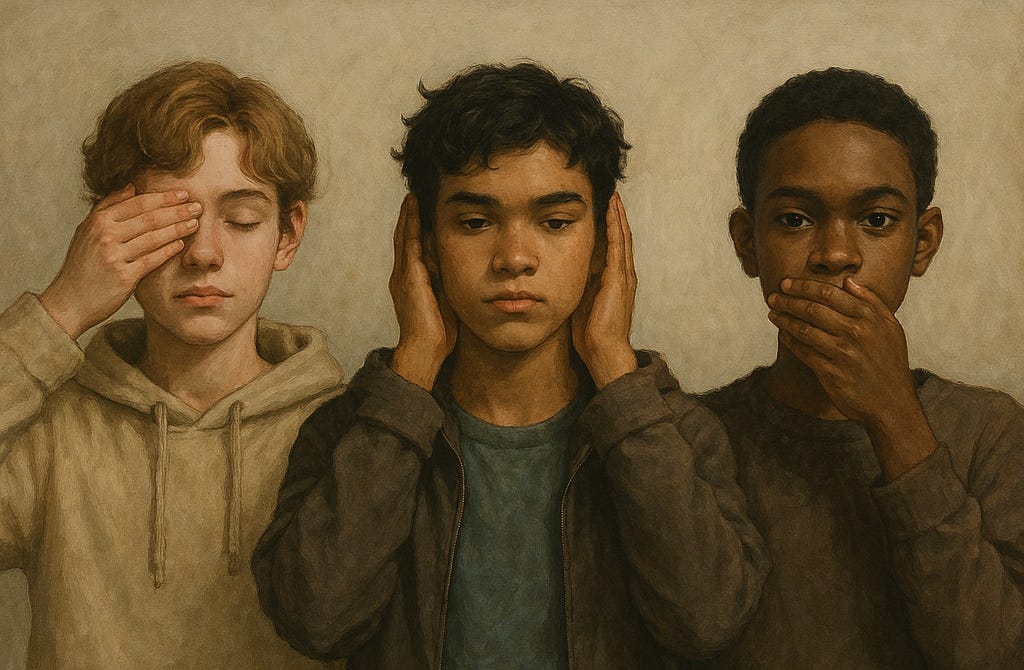
Secrecy vs privacy
It should be self-evident that principals and teachers, who act in locus parentis, need to know the sex of their charges in order to keep them safe. But, to the activists in InsideOUT, that is heresy. In their recently updated guidance to schools they insist that students in schools have the “right” to demand:
secrecy about their trans identity
compelled speech
open access to single sex spaces.
So entranced are they by these claims that activists now declare that a person’s sex is no longer public knowledge, available at the blink of an eye, but has become private medical information that may not be divulged to anyone else.
The concept of privacy - where personal information is shared with the people who need to know it - is being usurped by an insistence on secrecy - where personal information is to be withheld without exception.
Unreliable advice
The secrecy recommended to schools, where parents are kept in the dark about their child’s social transition, is in breach of the Care of Children Act (s.5) which says, “a child’s care, development, and upbringing should be primarily the responsibility of his or her parents and guardians.”
Compelled speech by way of compulsory pronoun usage is in opposition to our rights under the Bill of Rights Act (s.13) to “freedom of thought, conscience, religion, and belief… without interference.”
Asserting that any person can enter spaces that were intended for the opposite sex is counter to the Human Rights Act (s.46) that permits single-sex spaces “on the ground of public decency or public safety.”
The one concession that InsideOUT has made from its previous guidance is to admit that ‘gender identity’ is not in the Human Rights Act, but it cushions that blow by surmising, “Although it isn’t in the Act, they probably can’t treat you negatively because of your gender identity either (such as if you’re transgender or non-binary.)”
The law is presented as InsideOUT would prefer it to be, rather than as it is.
InsideOUT’s advice should not be relied upon by schools as none of its claims have been tested in a court of law.
In 2023 the Teaching Council publicly agreed that teachers do have the right to decline to use preferred pronouns. Other children, their parents, and staff all have the legal right to disagree with gender identity beliefs and to express their views respectfully, without the fear of censure.
InsideOUT’s dogmatic insistence on “rights” that are counter to our actual laws is setting up parents and children for unnecessary misunderstandings and conflict at school.
The landmine of false sex markers
Secrecy around birth certificates is a potential landmine for schools which could easily be caught in a situation where harm is caused either because they did not know the true sex of a child or because they were hiding that knowledge from other parents.
As far as we are aware, the MOE has not provided any advice to principals on how to manage conflicts that arise when children have an expectation that an altered birth certificate gives them special “rights”, let alone how to navigate when families are not truthful about a child’s sex.
The BDMRR does not oblige schools to accept birth certificates as incontrovertible evidence of sex.
Section 79(2b) says that anyone required to ascertain an individual’s sex may use the information in a birth certificate or any other relevant information.
Under the Privacy Act, a school cannot disclose a student’s transgender status except to prevent a serious threat to individual safety, and this threshold would not be met in most school situations. However, there is an obvious conflict between the school’s duty to protect the privacy of a child’s transgender ideation and the privacy and safety expectations of other students and parents in shared spaces.
Where a school knows a student has a cross-sex identity, one solution is to provide private changing or toilet cubicles and make them available for any student who seeks increased privacy. For camp accommodation, the trans-identified student can be placed in a smaller dorm room with close friends whose parents have given informed consent. These solutions protect privacy and uphold the rights of every student, while avoiding broader disclosure.
In contrast, the ‘solution’ offered by InsideOUT, that “You should be able to use the facilities you feel most comfortable using” does not meet the requirements of established law.
When a child has an altered birth certificate and their true sex is not disclosed, there is a potential for severe conflict. Instead of leaving legal uncertainty wide open for lobby groups to push their own agendas, the MOE needs to defuse the situation by urgently providing schools with policy advice that is consistent with the law.
A brief history of NZ birth certificates
Birth certificates replaced parish registers in the early 19th century with the purpose of recording the date and place each baby was born, its name and sex and its biological parents’ names. Even then, birth certificates were not 100% accurate because a husband, by law, was always recorded as the father when that was not always correct. (It was impolite - and possibly dangerous for the mother - to check.)
However, birth certificates remained largely accurate for 100 years until we started messing with them in an effort to be inclusive of other types of family relationships.
First came the change in 1955 that allowed closed adoptions, creating secrets that were strictly hidden until the 1985 Adoption Act gave adults and birth parents access to original documents.
From 2004, along with the birth mother, who has always been automatically registered, her female partner could be named as the second mother. This was done for the noble reason of providing continuity of guardianship for the child in the event of the death of the biological mother.
When same-sex marriage was legalised in 2013 and male same-sex couples could adopt, it became possible for two fathers to be registered.
Since 2023, when the BDMRR (sex self-ID Act) came into force, multiple changes to the sex marker on birth certificates have been permitted, for children as well as adults.
The final nail in the coffin of truthful birth certificates was the 2024 regulation that allows the baby’s parents to choose their descriptor. Either parent can elect to be mother, father, or parent. There are no restrictions - a woman can call herself ‘father’ if she wishes, and vice versa.
To date, those who wanted birth certificates to be treated as formal, historical documents have lost the battle. Birth certificates have become little more than guardianship declarations or mental health crutches.
Officially, birth certificates are no longer a record of genealogy but are a record of legal guardianship.
The birth register shows who the law recognises as the baby’s parents, rather than their genetic lineage.
What have we gained from all the above changes to birth certificates?
Foundational documents that cannot be relied upon for accuracy.
Validation of the belief that an altered birth certificate is evidence of a literal sex change (an impossibility).
Assertions that a new birth certificate conveys legal rights to single-sex spaces that it does not.
Secrecy and confusion in family genealogy and community relationships.
Is this what the public requested or expected?
Make birth certificates true again
To avoid inflicting further harm on children, it is time to re-confirm the primary purpose of birth certificates and stop mucking around with them. We need to restore them as accurate, foundational, government documents which cannot be altered apart from in exceptional circumstances. Where guardianship relationships with non-blood relatives need to be recorded, these should be registered separately.
In our submission to the Definitions of a Woman and Man Bill, RGE was too circumspect about what is needed. We did recommend that parliament “Consider all implications of enacting the definition of ‘sex’ to ensure that it operates coherently with all other legislation and can be applied consistently. Where there are conflicts or inconsistencies, enact provisions to overcome them.”
But we should have been much more direct in calling for the repeal of the BDMRR, as Mana Wāhine Kōrero did in its submission:
“If this Bill passes without directly overriding the BDMRR Act 2021, the self-identification process remains intact, creating an absurd administrative contradiction: the state will define a woman as a biological female in the Legislation Act 2019, while the Department of Internal Affairs will continue to issue female birth certificates to males.
A birth certificate must be restored to its proper legal standing: a permanent, unalterable historical record of permanent genetic reality at the time of birth.
Legal parenting arrangements, adoption details, and guardianship rights for same-sex partners must be managed through separate, secondary legal documents, leaving the primary birth registry structurally aligned with unalterable genetic reality.”
Children deserve to know the truth about their biological mother and father without having to uncover hidden documents. This equally applies to children who are born via surrogacy or who have been adopted. Put that information elsewhere and go back to the basics with only genetic facts on birth certificates.
Birth certificates have strayed far away from their original intended purpose and in some instances have become little more than vanity documents providing caregivers with ‘progressive’ credentials.
How are young children supposed to value honesty when they see adults pretending that a child or teacher has changed sex?
How are they supposed to comprehend reality when a classmate’s mother is being called “Dad”?
Until we fix the falsehoods in birth certificates, we can’t fix the downstream effects on schools, which were barely considered when the BDMRR was debated and passed unanimously in 2021. Thanks to the lack of forethought in our parliament, accepting birth certificates at face value has become a safeguarding risk in schools.
By Fern Hickson
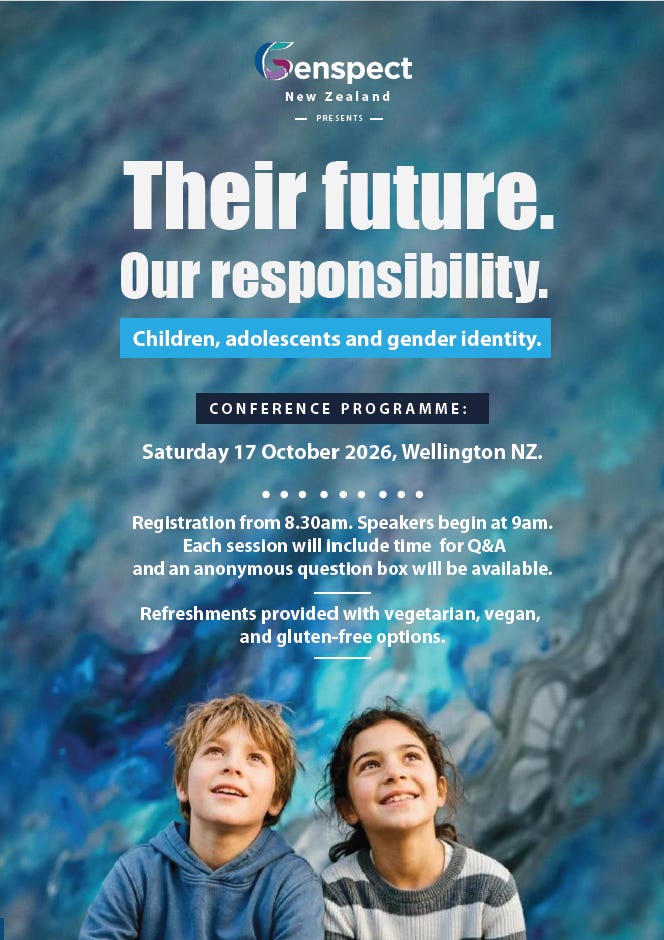
PS. Don’t miss buying an early bird ticket before 31 August to hear Dr Stella O’Malley (online or in person) at the Genspect Conference in Wellington on 17 October. Click here for the full programme and to buy tickets.
As a lesbian with 2 children born before the law change in 2004, my children do not have my partner listed as their other parent, and I would not want them to. She knows she is their other parent, as do they. A birth certificate should reflect reality. The status of their other parent can be sorted out with a legal agreement. It is a lie to put 2 men or 2 women on a birth certificate, just as it is to rename yourself from mother to 'parent' or father to 'mother', or to change the sex marker on a birth certificate. Previously, birth certificates were used as legal proof of identity. Now they are just useless, meaningless documents.
When you are a teacher and there is a trans student in your class, every time you have to use their preferred pronouns or act as though they are the sex they are not, you are forced to speak lies and to pretend you believe something you don't.
You can't say anything negative, you can't disagree, you can't refuse. You can't tell the other students that what they are seeing and hearing isn't true. All day and every day you must pretend, lie and act as though there is no elephant in the room. You model to all the students how to allow and facilitate one person to live a life that is false and untrue and make clear to them that they must do the same.
Once we had a children's story about an emperor's new clothes where the tailor pretended to create clothes and the emperor pretended to see and wear the beautiful garments when the truth was that he was in his underwear. This is what the trans movement is all about. We must all pretend that boys are girls and girls are boys and everyone is too scared to shout out the truth. The truth is - you can't change your biological sex.